Award-winning work · AI recreation
Pictionary · 2026
Micro-worlds. Macro-impact.
Award-winning work · AI recreation
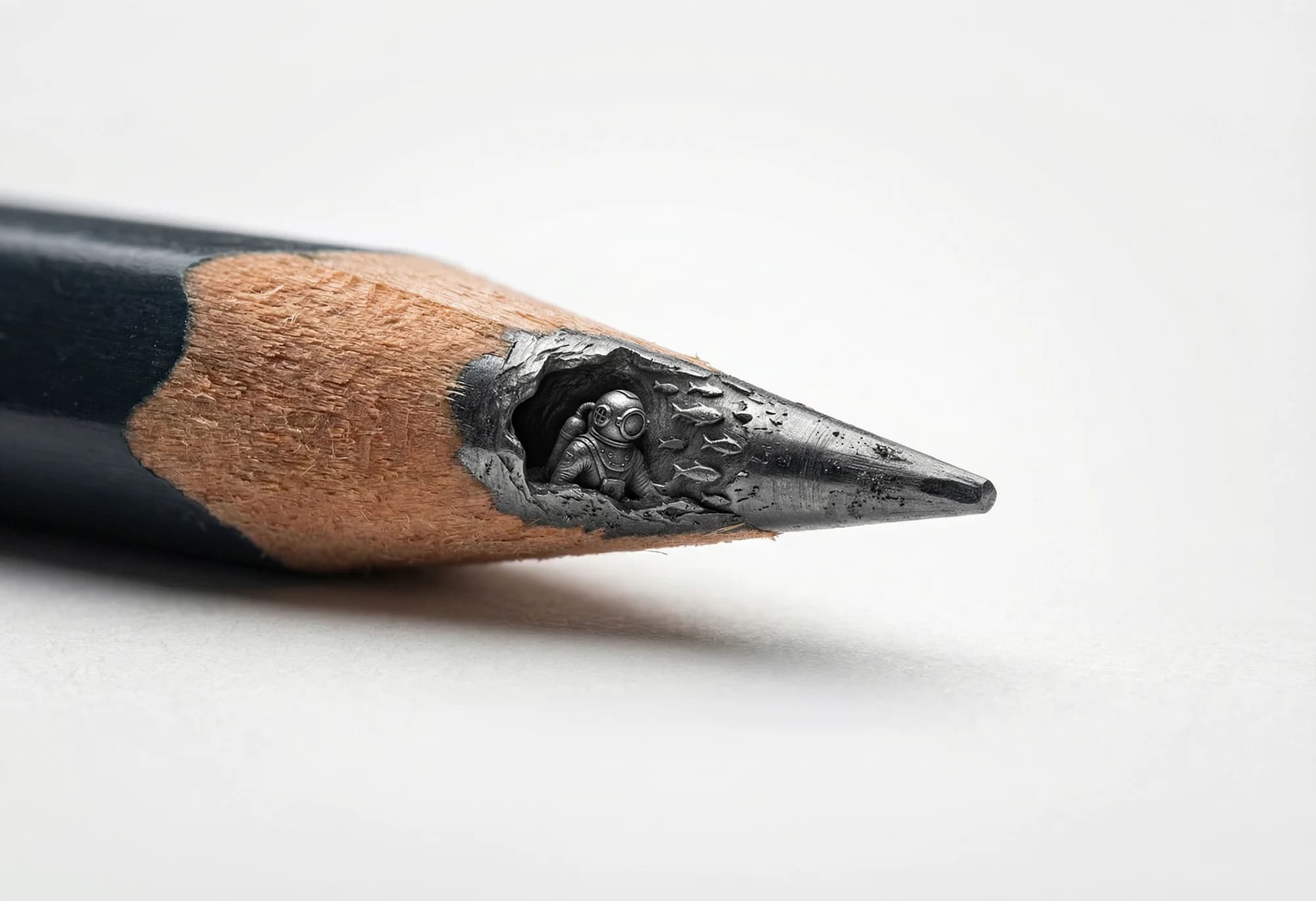
An award-winning Pictionary campaign for Mattel that I worked on at Ogilvy, recognised at El Ojo de Iberoamérica and Lürzer's Archive in 2012, rebuilt now with a modern generative pipeline. The idea: inside every pencil there's a whole world waiting to be drawn.
Original campaign: creative team at Ogilvy for Mattel. Modern recreation: generative pipeline design, LoRA training, ComfyUI, compositing.
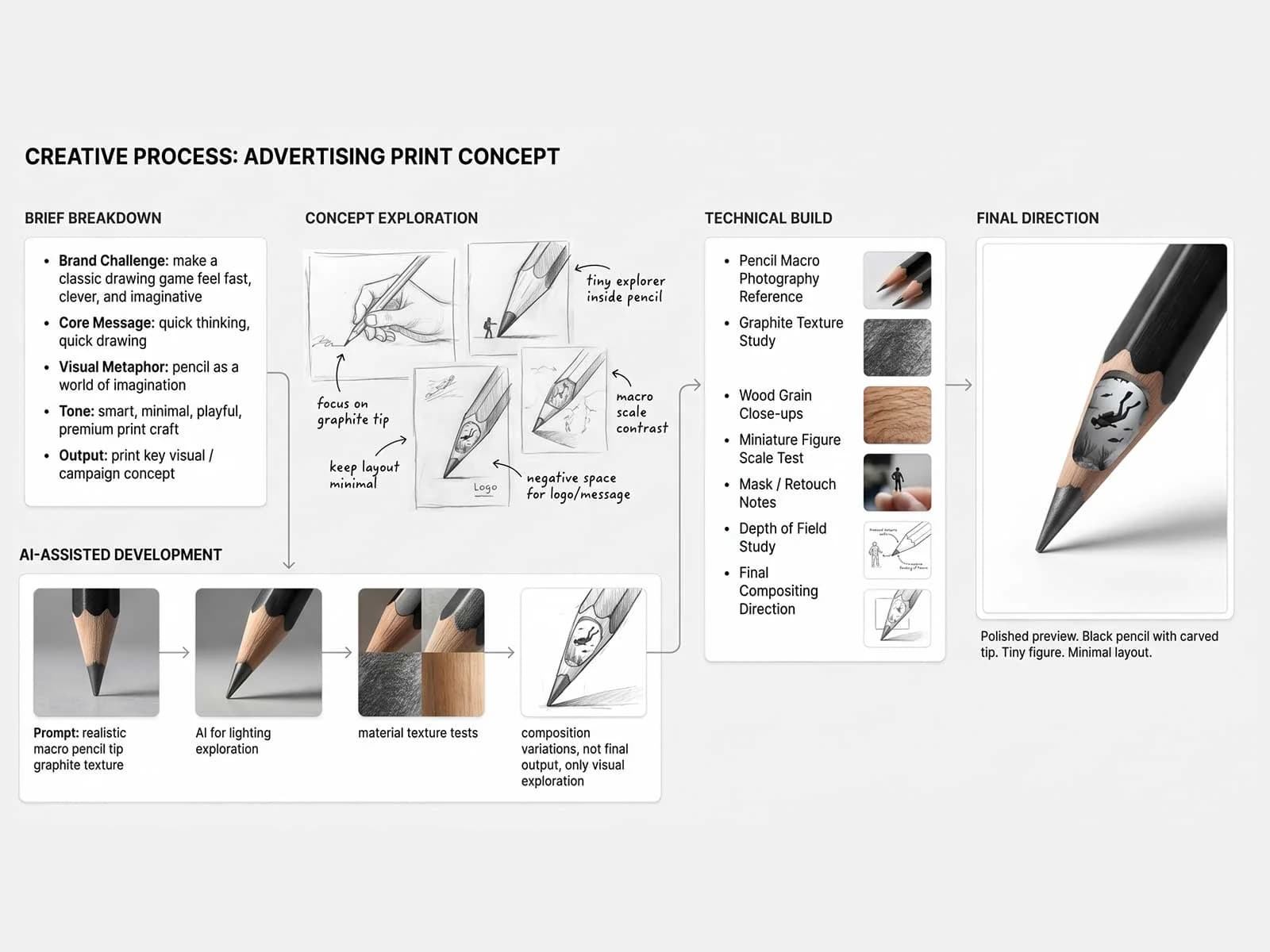
The brief, decoded
The original campaign carried one idea: inside every Pictionary pencil there's a whole world waiting to be drawn. Years later I rebuilt one of the hero frames, the pencil carved open to reveal a tiny diver inside the graphite, this time using a fully generative pipeline instead of the original CGI and retouching.
The challenge was believability. Miniature realism lives or dies on macro depth-of-field and material truth, the grain of the wood, the wet sheen of the graphite, the diver's scale against the carved cavity.
The idea and the obstacle
The piece turns a pencil into an ocean. The graphite tip is carved open like a dive site, and a single miniature diver descends into it. Shallow macro focus and precise scale cues sell the illusion instantly: this is vast, and it is the size of a pencil.
The technical challenge was holding the pencil's exact identity, its colour, proportions and branding, while sculpting a believable underwater scene into the graphite tip.
The pipeline, node by node
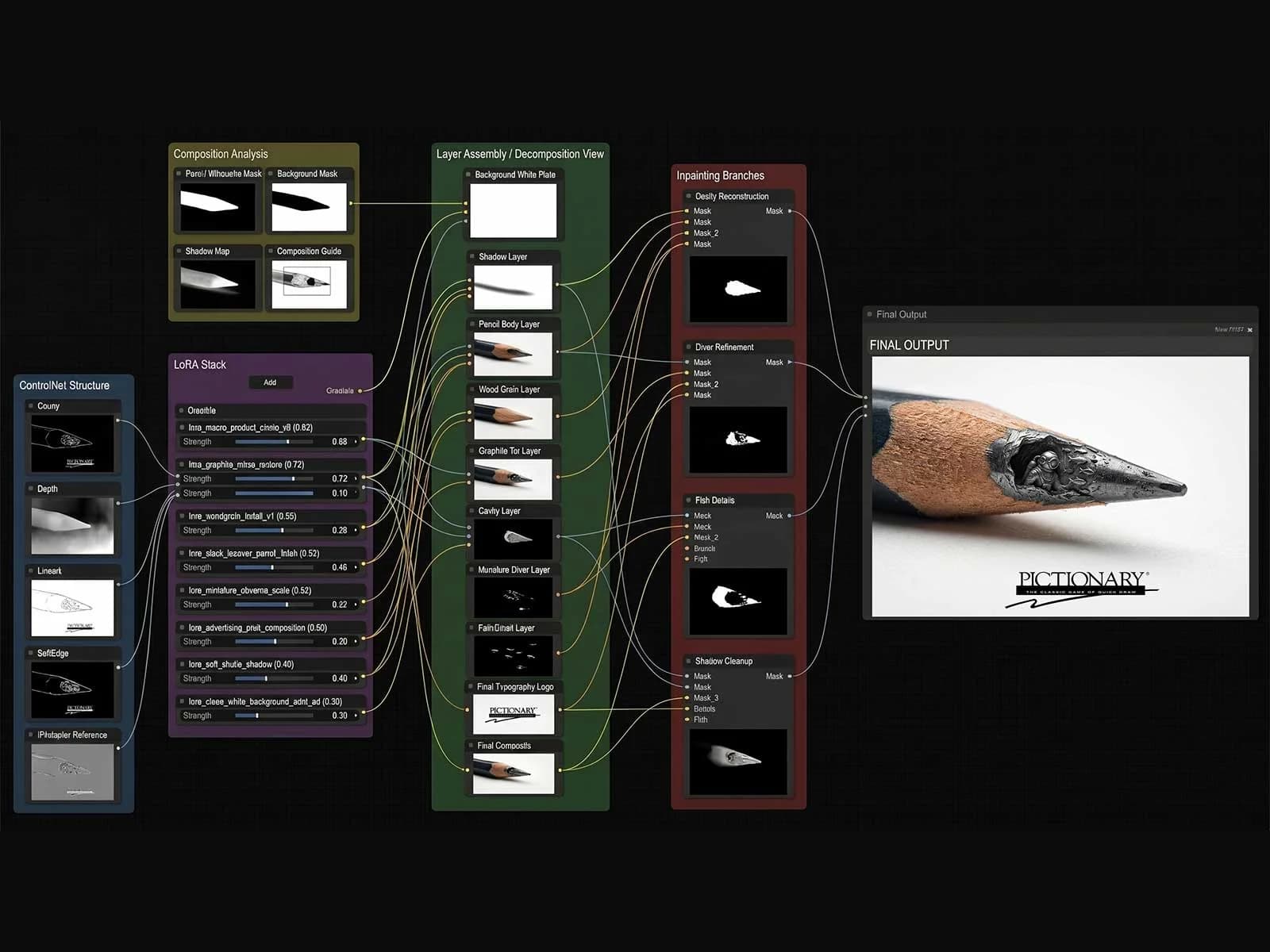
I trained a LoRA on the pencil's material and form so the wood, paint and graphite stayed locked and true. The ComfyUI graph layered that with ControlNet depth to drive the shallow macro focus and the exact placement of the diver inside the carved tip.
The frame was decomposed into separate passes, pencil body, wood, graphite tip, the diver and shadow, then assembled and graded so the tilt-shift macro look could be dialled in without re-rendering.
LoRA Dataset
- Trained domain
- Pictionary product family: colour, form, branding cues
- Dataset
- 62 curated reference images
- Training
- 2,200 training steps, batch 4
- Base model
- FLUX.2 Kontext
ComfyUI Workflow
- 01 · Checkpoint Loader
- Base model: FLUX.2 Kontext base weights
- 02 · LoRA Loader
- Product model: pictionary_v2, strength 0.78
- 03 · CLIP Text Encode
- Conditioning: scene prompt pair for the carved tip
- 04 · ControlNet Apply
- Structure: depth map for macro focus, weight 0.7
- 05 · IPAdapter
- Material: surface and proportion consistency, weight 0.65
- 06 · KSampler
- Sampler: dpmpp_2m, 30 steps, CFG 4.2
- 07 · VAE Decode
- Output: macro render pass
Conditioning Notes
Depth ControlNet to drive convincing macro depth-of-field and miniature scale
Product LoRA to lock the pencil branding cues and proportions
IPAdapter to keep material identity consistent across the build
Output Specs
- Lighting
- Soft top key with macro-scale falloff
- Color grade
- Warm, saturated, playful
- Brand check
- Pencil colour and proportion held true to the product
Layer Decomposition
- Scene render
- LoRA-driven pencil with the carved dive-site tip
- Focus pass
- Tilt-shift depth blur isolated
- Subject relight
- The diver and carved cavity brightened as the focal point
- Color grade
- Warm, playful campaign grade
Final Output
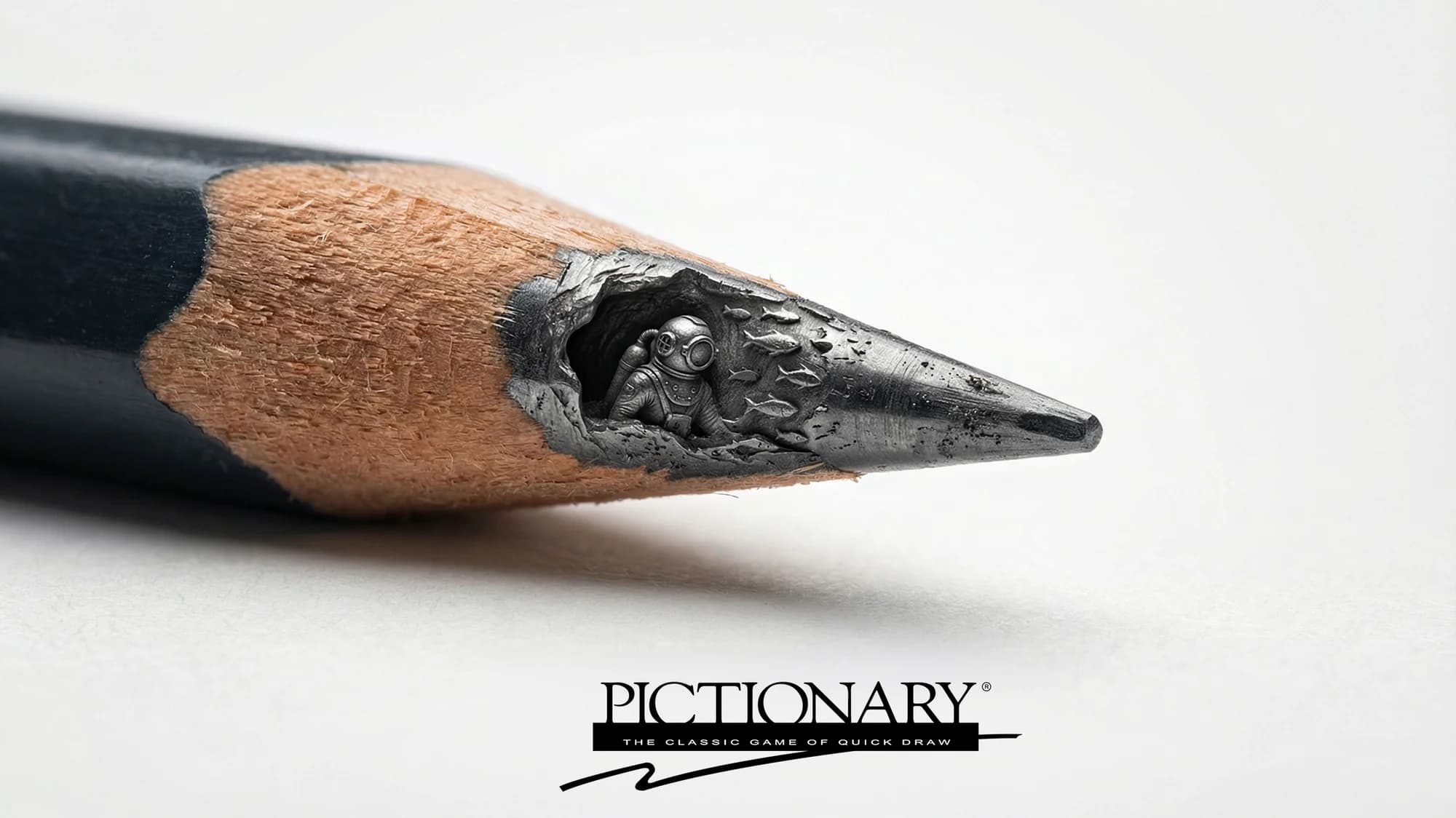
- Lighting
- Soft top key with macro-scale falloff
- Color grade
- Warm campaign grade applied over isolated focus and grade passes. Tilt-shift macro aesthetic dialled in post, no re-render.
- Brand check
- Pencil colour and proportion held true to the product